The ninety-day plan
Most local SEO engagements fail on sequencing, not on skill. The work gets done in the order it appeared on a list, the slowest item starts in week nine, and ninety days later there is nothing to show — because the only signals that would have moved needed ninety days and were given three weeks.
The individual tasks are all in Part II and none of them is hard. What decides whether a quarter ends with evidence or with excuses is which task you start on day one.
Why the unit is a quarter
Ninety days is the shortest window that contains a real measurement.
A trend needs three readings, not two — two points always draw a line, and half of those lines are noise. Readings must be far enough apart to be independent: a fortnight is the floor, because (inference) profile and review changes tend to show over weeks rather than days (Did it work?).
Then do the arithmetic. A baseline plus three fortnightly readings is seven weeks, and that assumes the change landed on day one. It never does. Add access, publication latency and one buffer, and you are at twelve weeks.
So the calendar is set by the slowest signal you promised to move. Promise something that needs six months and ninety days is a fraud however hard you work; promise only things that land in a fortnight and you have sold a week of work on a quarterly retainer.
Pricing that honestly is What the work costs; scheduling it is this chapter.
The four clocks
Every task in local SEO sits on one of four clocks. Sorting the work by clock, before sorting it by anything else, is what this chapter exists to teach.
| Clock | Work on it | How long it takes | Who has to act |
|---|---|---|---|
| Write | Phone, website link, hours, description, attributes, photos, service areas | Minutes to publish, an afternoon to do all of it | You |
| Behaviour | New reviews, replies, posts, photos from customers | Weeks — you act, other people respond | You and the client's staff |
| Aggregate | Review count, rating, reply rate, citation consistency | A quarter, by construction | Everyone, slowly |
| Instrument | Trend lines, comparable re-scans, the change log | As long as you have been measuring | You, on a schedule |
The write clock is fast but not free of risk. Most ordinary field edits go through Google's review before they become public — usually minutes, sometimes days (LSM-GBP-07).
Name, category and address are a different class. They can put a listing into re-verification and out of Search and Maps for hours to days (Suspensions and reinstatement).
An edit can also be silently rejected — the field reads its old value after the next refresh, and that is the answer, not a bug (write limits and failure modes).
The aggregate clock dictates the calendar, because you cannot compress it. Getting a business from 12 reviews to 20 is not an afternoon's work at any price — it is a rate problem.
The thresholds are counters, not tasks. Two different gates want two different numbers, and neither can be bought:
| Gate | What it wants |
|---|---|
| Profile audit | Review volume at 20, rating at 4.0 |
| AI-readiness rubric | 25 reviews, 4.2 rating, a review inside the last 60 days, replies on at least half |
Every one is a counter moving at the speed customers arrive: month-3 outcomes of month-1 decisions.
Which produces the inversion, worth saying flatly because it feels wrong:
Start the slow work first and do the fast work while it runs. Quick wins are called quick because they can be done at any time. That is precisely why they should not be done first.
The instrument clock is the one people forget. Nothing re-measures on its own — every reading is a deliberate, usually priced action, and there are no recurring background jobs.
The trend chart is opportunistic, not scheduled. The snapshot feeding Profile score over time lands at most once per business per calendar day, and only on days you actually refreshed something — any of the profile, rankings, competitor or review refreshes writes it; a day nobody touched the business writes nothing.
Refresh twice in a quarter and the chart has two points on it, with no way to fill the gap retroactively.
The generated plan is a first draft
Open the overview and Action plan — your next steps is already sitting there, ordered, with impact labels and point values. It is a useful starting object and it is not a schedule. Knowing how it was built is what lets you overrule it with confidence.
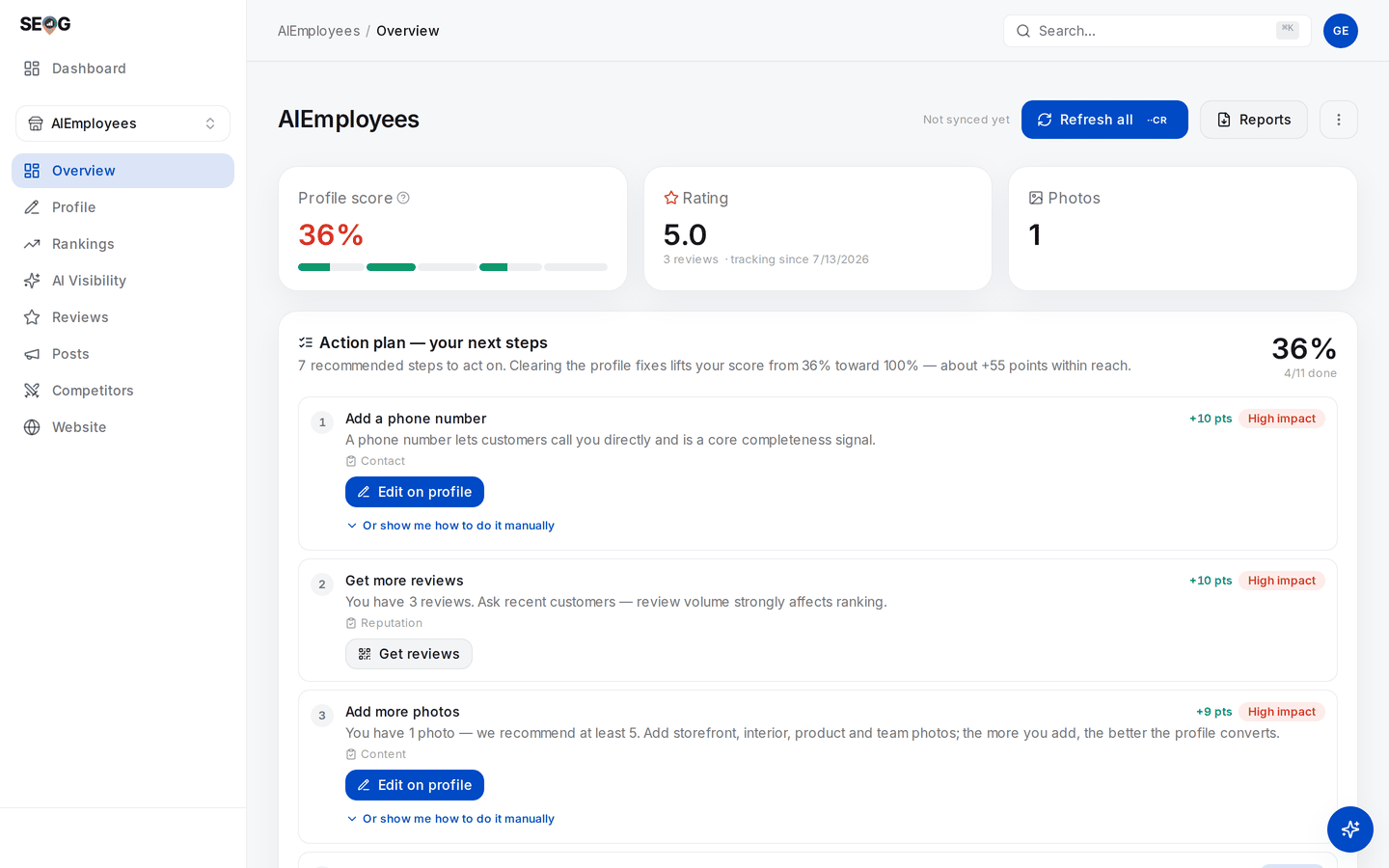
A real plan on a real profile, and a good illustration of the argument. Seven rows, each with a point value and a tier. Add a phone number and Get more reviews both read "+10 pts, High impact" — one takes ninety seconds and the other takes a quarter. The list is arithmetic on completeness weights; the sequencing is your job, and it is the job you are paid for.
How the list is built
It merges three sources into one deduplicated list:
- the failing checks from the weighted profile audit;
- the AI-readiness factors the audit does not already cover;
- any stored website and listing fixes.
Only two AI factors survive that deduplication — Get a fresh review and Reply to your reviews — because everything else in the readiness rubric is already an audit check. And when the audit's own review-volume check has also failed, Get a fresh review is folded into it rather than listed twice, so you often see just the one row.
The sort is impact tier first, then recoverable profile-score points, then alphabetical by title.
For a profile-audit row the impact tier is a pure function of that check's weight: 9 or more is High impact, 6 to 8 is Medium, below 6 is Low.
The other two sources are tiered on their own scales rather than on audit weight: the AI-visibility rows from the readiness factor's weight, the website and listing rows from the stored fix's priority. So a tier compares rows within a source, and comparing tiers across sources means less than the shared label suggests.
What the list cannot see
A tier is arithmetic on a weight — never a judgement about your business.
Which is why you never work this list top-down. Three consequences:
It cannot see effort. "Add your opening hours" and "Get more reviews" both carry 10 points and both land in the High tier. One is ninety seconds. The other is a quarter of somebody's life.
It cannot see risk. Nothing in the ordering knows that editing a category can pull the listing out of Search for two days, or that doing so in week eleven destroys your final measurement.
It cannot see catastrophe. "Fix your business status" — the check that fails when a profile is marked closed or temporarily closed — weighs 4, so it is tagged Low impact. A business marked temporarily closed is close to invisible.
If you see that row it is the only thing you do that day, and the label says the opposite. A weight is a share of a completeness score, not a measure of consequence.
One whole category of finding is structurally absent. The plan is computed from stored profile, review, website and listing data without looking at a single search result, so it will never tell you the market is hard or that the constraint is proximity rather than completeness. That comes from a rank map, and it is often the most important sentence in the engagement.