The Local SEO Manual
Most SEO guides teach you vocabulary. This one teaches you to look at a real business and know what is wrong with it.
Local SEO is the practice of getting a business that serves a place — a dentist, a plumber, a coffee shop, a law firm — to show up when someone nearby searches for what it sells. It is a genuinely different discipline from the SEO that gets a blog post ranked. The ranking factors are different, the results page is different, and the thing being ranked is not really your website at all.
It is also unusually learnable, because the feedback is fast and much of the ground truth is public. Almost everything your competitors have done to their public profile is visible to you. Most of what you do is measurable within days.
Who this is for
- Business owners who are paying someone for local SEO and cannot tell whether it is working.
- Freelancers and agency staff who need to actually deliver the service, not just sell it.
- Marketers and developers who know classic SEO and keep being surprised by how local behaves.
You need no prior SEO knowledge. You need one real business to practise on — yours, your employer's, a friend's, or a local business you pick out of a map (most of the manual works read-only on a business you do not own).
How this manual is different
Every chapter has two halves.
Theory — what the mechanism is, what Google is actually measuring, and why. No lists of "200 ranking factors." Local search runs on a small number of forces, and once you can see them you can reason about situations no checklist covers.
Labs — you do the thing, on a real business, and look at the result. Reading that proximity dominates local rankings teaches you a sentence. Watching your own business rank #2 at your front door and vanish three miles away teaches you the job.
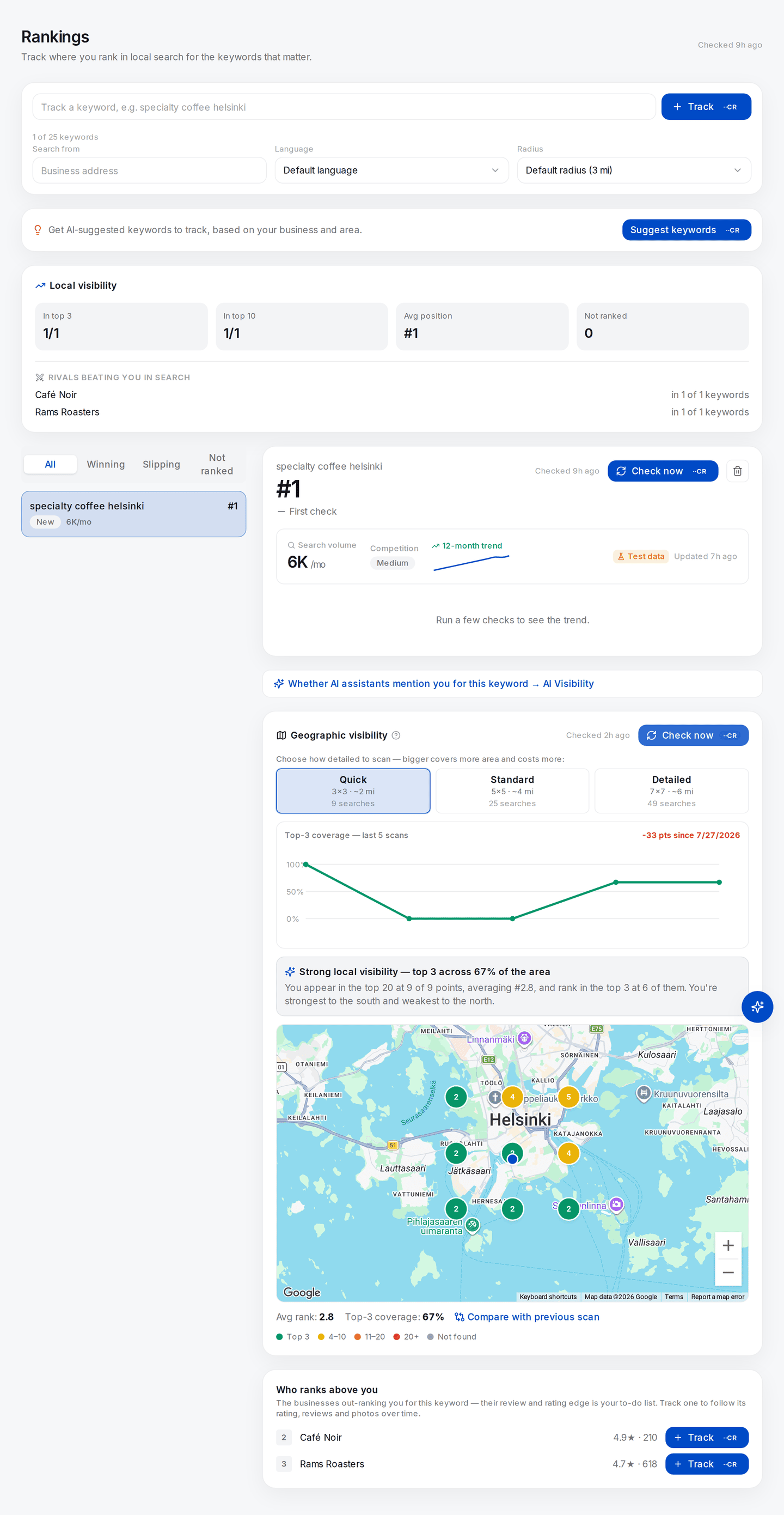
A real scan, not a diagram: nine live searches for one keyword, one per pin, run back-to-back in a single scan. The rank is not identical at every pin — and that variation is exactly what a single "we rank #1" number hides. (The "Test data" badge further up that screen sits on the search-volume box, not on the grid. No search-volume provider was connected on the machine that took the shot, so that one box is showing sample figures — labelled as such, rather than passed off as measurements. The grid positions are real.)
The labs run in SEOG — a local-SEO platform with a free account. We built SEOG, and we wrote this manual; that is worth knowing up front. It is also why the labs are precise instead of vague: we can tell you exactly which screen to open and exactly what you should see, which is not something a tool-agnostic guide can do.
You are not required to use it. Every lab states the underlying concept and the raw data source, so you can reproduce the work by hand, with a spreadsheet, or with another tool. It will just take considerably longer.
What you will be able to do at the end
- Look at any local business and diagnose why it is or is not visible.
- Measure visibility properly — as a map, not a number.
- Fix the profile, the reviews, the citations and the site, in the order that actually moves rankings.
- Read a competitor's strategy off their public data.
- Tell whether an AI assistant recommends the business, and change the answer.
- Report all of it to someone who is paying for it.
How to read it
The manual is written to be read in order — later chapters assume the vocabulary and the workbench from earlier ones. If you are impatient, the honest shortcut is:
- Never done any of this → start at How the labs work and go straight through.
- You own a business and want results this month → Start here, then Part II, then come back to Part I when something surprises you.
- You already do SEO professionally → skim Part I for the local-specific model, then work Part II and Part III properly.
| Part | What it covers |
|---|---|
| Start here | The lab format, the free account, picking a practice business |
| Part I — Foundations | The map pack, the ranking forces, what a business is to Google |
| Part II — Core practice | The working loop: measure, diagnose, fix, re-measure |
| Part III — Advanced | AI answers, spam, suspensions, multi-location, structured data |
| Part IV — Operating | Reporting, 90-day plans, automation, selling the service |
| Appendix | Lab costs, glossary, checklists, contributing |
A note on honesty
Local SEO attracts a lot of confident nonsense, because the results are location-dependent and therefore easy to misrepresent. Two rules this manual holds itself to:
- If we are not sure, we say so. Google publishes very little about local ranking. Where something is inference from observed behaviour rather than documented fact, it is marked as such.
- No fabricated data, anywhere. Not in the manual, and not in the tool — when SEOG cannot get a real answer from Google, it shows you nothing, or a sample carrying a badge that says so. What it never does is put an unlabelled plausible number where a measurement should be. A ranking tool that invents positions is worse than no tool.
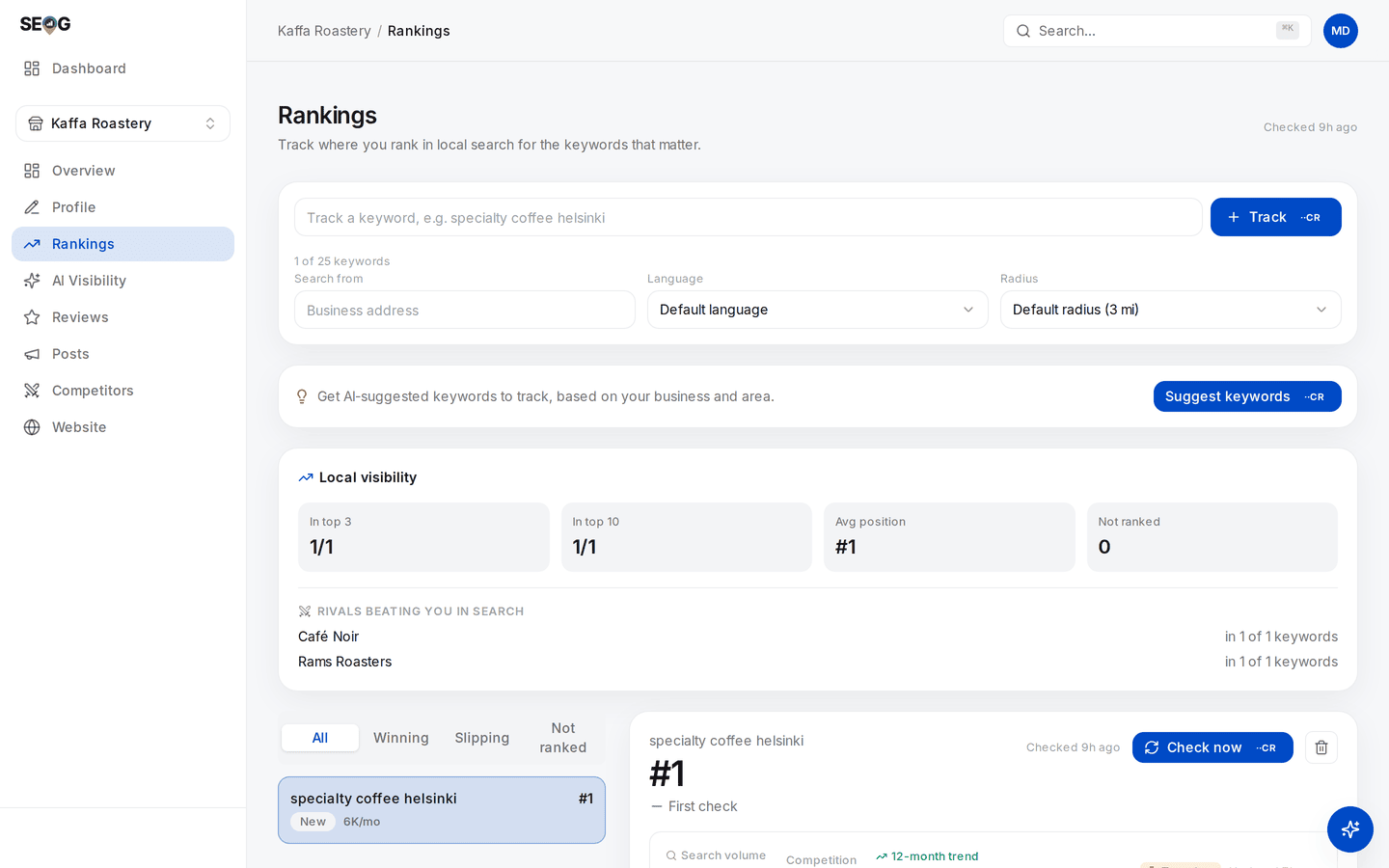
The rule in practice. With nothing tracked yet, the screen shows three greyed rows and says so in the panel header — "Example of how tracked keywords appear". Those positions are placeholders, not measurements. Learn to read that label: a panel that will not tell you where its numbers came from is a panel to distrust.
License and contributions
Free to read, free to share, free to teach from — CC BY 4.0. The source is on GitHub; corrections and new labs are welcome. See Contributing.
Next: How the labs work →